
Our News
11+ Years Expertise | Professional Fastener Manufacturer | Standard & Custom Parts | DIN, ISO, ANSI Certified | Strong R&D | Ample Stock | Cost-Effective |
Professional Team | Serving 40+ Countries | Reliable Logistics
Home » Our News 2 » Hex Bolt Work and Applications
Hex Bolt Work and Applications
How Do Hex Bolts Work?
Depending on the application, hex bolts are used either in pre-tapped holes or along with nuts. A range of tools such as a hex bolt wrench, spanners, hex keys, socket sets, ratchet spanners, etc are used to tighten the bolt. The hexagonal head provides enough grip from various angles for the tool operator which eases the installation and removal process. Here’s how a hex bolt works:
Threaded Shaft and Hexagonal Head:
Hex bolts have a threaded shaft with spiral grooves known as threads. These threads correspond to the threads in a compatible nut or threaded hole. The hexagonal head of the bolt is designed for easy gripping using a wrench or socket tool.
Insertion:
To use a hex bolt, you start by inserting the threaded end of the bolt through the parts you want to fasten together. The length of the bolt should be sufficient to accommodate the thickness of the materials being connected.
Hex Nut (Optional):
If you’re using a hex nut, you thread it onto the threaded shaft of the bolt from the opposite side of the materials. The hex nut is turned clockwise onto the threads, and as it moves along the shaft, it pulls the parts being fastened closer together.
Tightening:
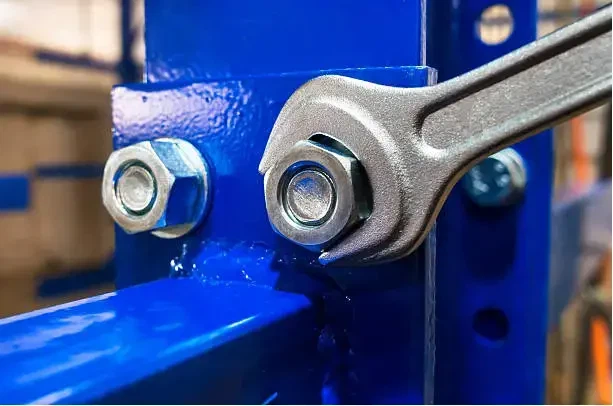
Using a wrench or socket tool, you grip the hexagonal head of the bolt and rotate it clockwise to turn the bolt into the nut or threaded hole. As the bolt is turned, the threads of the bolt engage with the threads of the nut or threaded hole, causing the bolt to move forward.
Compression and Clamping Force:
As the bolt is tightened, it exerts an axial force on the connected parts. This axial force compresses the materials together, creating a clamping force that holds them in place. This compression ensures a secure and stable connection that resists movement and separation.
Locking Feature:
The resistance generated by the threads between the bolt and the nut or threaded hole provides a locking feature. This helps prevent the bolt from inadvertently loosening due to vibrations, impacts, or external forces.
Torque and Tightness:
The torque applied to the bolt determines the level of tightness achieved in the connection. Proper torque ensures that the fastened components are securely held together without damaging the materials or the threads. ASME PCC-1 provides a formula to calculate the required torque for bolting.
Adjustability and Removal:
The use of hex nuts allows for adjustability and ease of removal. If you need to disassemble the connection, you can simply reverse the rotation of the bolt to unthread it from the nut or threaded hole.
In summary, hex bolts work by threading the shaft into a compatible nut or threaded hole, creating axial force, and clamping the connected components together. The hexagonal head provides the necessary torque for tightening, and the threaded shaft and nut interaction prevents the connection from loosening over time.
Applications of Hex Bolts
Hex bolts find application in a myriad of industries and projects, ranging from construction to manufacturing. Some common applications include:
Construction:
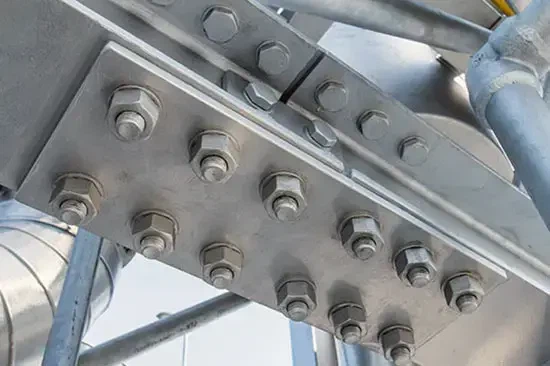
Hex bolts are frequently used in construction for joining structural components (Fig. 3) like beams, columns, and trusses. They provide the necessary strength and stability to support heavy loads and ensure the safety of the structure.
Automotive and Machinery:
In the automotive and machinery industries, hex bolts are used to assemble engine components, chassis parts, and machinery frames. Their durability and strength are crucial for maintaining the integrity of these systems.
Furniture Assembly:
Hex bolts are often used in assembling furniture due to their ease of use and strong fastening capabilities. From bed frames to bookshelves, hex bolts provide the necessary stability for everyday use.
Infrastructure Projects:
Hex bolts play a role in large-scale infrastructure projects, such as bridges, tunnels, and railways, where their robustness is vital to ensure the safety and longevity of the structures.
Manufacturing:
Hex bolts are employed in manufacturing processes for assembling machinery, equipment, and production lines. They ensure that the parts are securely fastened together, preventing malfunction and improving overall operational efficiency.
Electronics:
In electronics manufacturing, hex bolts are utilized for securing components within equipment and devices. Their small size makes them suitable for applications where space is limited.
Aerospace and Aviation:
The aerospace industry relies on hex bolts for assembling aircraft components, engines, and critical systems. The high strength and reliability of hex bolts are crucial for ensuring the safety of air travel.
Renewable Energy Projects:
In solar panel installations and wind turbine construction, hex bolts are used to fasten frames, mounts, and structural components. Their resistance to environmental factors is important in outdoor applications.
Marine and Shipbuilding:
Hex bolts are essential for marine applications due to their resistance to corrosion in saltwater environments. They are used in shipbuilding, boat construction, and offshore structures.
Railways and Transportation:
Hex bolts are used in the construction and maintenance of railway tracks, bridges, and transportation infrastructure to ensure safety and stability.
Oil and Gas Industry:
Hex bolts are employed in the oil and gas sector for assembling equipment, pipelines, and infrastructure in both onshore and offshore facilities.
Communication Towers:
Hex bolts play a role in assembling communication towers, antennas, and transmission equipment to ensure stability and reliability.