Home » What is the difference between large hexagonal head high strength bolts and torsion shear type high strength bolts?
Reuse of Fasteners: A Sustainable Solution in Modern Construction
Reusing fasteners is a practical and sustainable solution to reduce construction waste and environmental impact. As challenges exist in different
The Hidden Threat of Fastener Fatigue
Fastener fatigue is a phenomenon that occurs when a fastener undergoes repeated cycles of stress over time which is common
Dangers of Fastener Embrittlement
Understanding the threats that can risk the integrity of components in structures such as fastener embrittlement can lead to preventing
The Future of Smart Fasteners
The future of using smart fasteners in manufacturing, construction, and other industries has a bright potential to enhance the functionality
High-Performance Fasteners for Aerospace
As technology advances and materials continue to evolve, the aerospace industry rely on innovative fastener solutions to meet the growing
Fastener Testing and Quality Control
For some applications that require intricate and reliable fastener devices like automotive, aerospace, and construction, safety is a paramount detail
What is the difference between large hexagonal head high strength bolts and torsion shear type high strength bolts?
A. the difference in appearance.
Large hexagonal head high-strength bolts and torsion shear high-strength bolts are different in appearance. The head of large hexagonal head high-strength bolts is hexagonal, while the head of torsion shear high-strength bolts is semi-circular, and its tail comes with a plum head.
B. The difference in installation.
Large hexagonal head high-strength bolts are installed with a torque wrench. The torsion shear high strength bolt is controlled by the plummer head at the end of the installation process, and the torque is used to reverse the bolt until the straight tooth-like end of the bolt is broken.
C. Differences in matching.
Large hexagonal head high-strength bolts and torsional shear high-strength bolt packages are not the same. Large hexagonal head high strength bolts are composed of a bolt, a nut and two flat pads. And torsion shear high strength bolts are composed of a bolt, a nut and a flat pad.
D. The difference in torque.
The torque of the large hexagonal high-strength bolts is controlled by the construction tools, while the construction of torsion shear high-strength bolts to use a special electric wrench, which belongs to the self-scaling type bolts, whose construction tightening torque is determined by the diameter of the cutout between the screw and the plummer head at the end of the bolt, that is, by its torsional breaking torque to control.
In general, large hexagonal high-strength bolts belong to the high-strength grade of ordinary screws, while torsion shear high-strength bolts are the improved type of large hexagonal high-strength bolts, although they are the same kind of bolts, but there are still great differences in some subtle aspects. Compared with the two, torsion shear high strength bolts have the advantages of easy construction, intuitive inspection, good force, quality assurance, etc. Most of the high-rise steel structure projects use this form.
Large hexagonal head high strength bolts and torsion shear high strength bolts are one of the main products of Zhejiang Myway Co.,Ltd, complete specifications, spot supply, the product is recognized by the market, many corporate customers repurchase rate is very high, also very much looking forward to working with you, can send e-mail: ashley@myway-metal.com, fast access to preferential bolt quotation.
2. Hardness and Strength
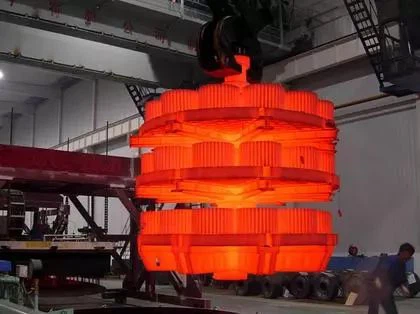
In the inspection of threaded fasteners, we cannot simply look up the hardness value in the relevant manual and convert it into a strength value. There is an influence of hardenability factor. Because GB3098.1 and GB3098.3 stipulate that the arbitration hardness is measured at the 1/2 radius of the cross section of the part. The tensile test specimen is also cut from the 1/2 radius. Because it is not ruled out that the center part of the part has a low hardness and low strength part.
Generally speaking, the material has good hardenability and the hardness can be evenly distributed on the cross section of the screw. As long as the hardness is qualified, the strength and guaranteed stress can also meet the requirements. However, when the hardenability of the material is poor, although the hardness is qualified according to the specified parts inspection, the strength and guaranteed stress often do not meet the requirements. Especially when the surface hardness tends to the lower limit.
In order to control the strength and guaranteed stress within the qualified range, the lower limit of hardness is often increased. For example, the hardness control range of grade 8.8: for specifications below M16, it is 26~31HRC, and for specifications above M16, it is appropriate to be 28~34HRC; for grade 10.9, it is appropriate to control it at 36~39HRC. Grades above 10.9 are another matter.
3. Re-Tempering Test
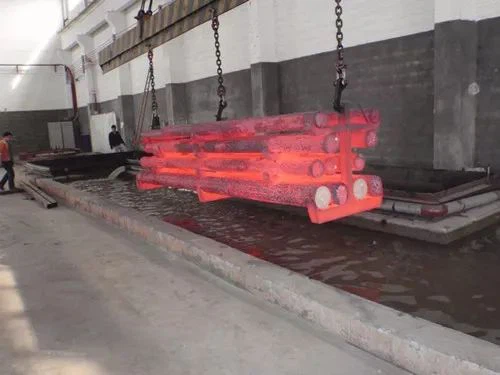
Bolts, screws and studs of grades 8.8 to 12.9 should be re-tempered for 30 minutes at a temperature 10°C lower than the lowest tempering temperature in actual production. On the same specimen, the difference in the average hardness of three points before and after the test shall not exceed 20HV.
The re-tempering test can check the incorrect operation of using too low a temperature to barely reach the specified hardness range due to insufficient quenching hardness, and ensure the comprehensive mechanical properties of the parts. In particular, threaded fasteners made of low-carbon martensitic steel use low-temperature tempering. Although other mechanical properties can meet the requirements, the residual elongation fluctuates greatly when measuring the guaranteed stress, which is much greater than 12.5um. Moreover, sudden fractures may occur under certain conditions of use. Sudden fractures have occurred in some automotive and construction bolts. The above phenomenon can be reduced when tempering at the lowest tempering temperature. However, special caution should be exercised when making 10.9 grade bolts with low-carbon martensitic steel.
4. Hydrogen Embrittlement Inspection
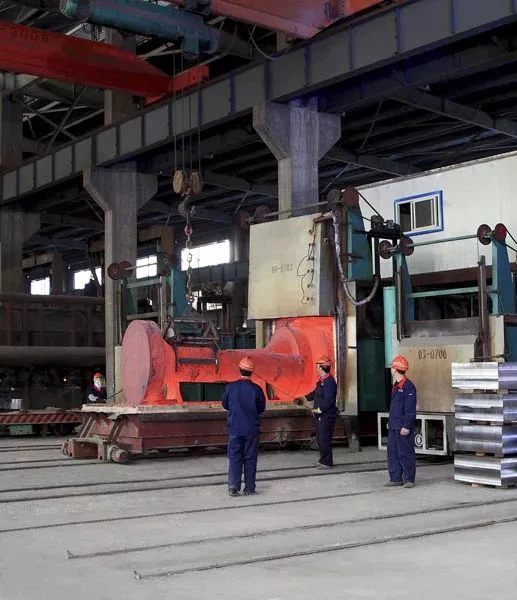
The sensitivity of hydrogen embrittlement increases with the strength of the fastener. For external threaded fasteners of grade 10.9 and above, surface hardened self-tapping screws, and combination screws with hardened steel washers, etc., dehydrogenation treatment should be carried out after electroplating.
Dehydrogenation treatment is generally carried out in an oven or tempering furnace at 190~230℃ for more than 4 hours to diffuse hydrogen.
Threaded fasteners can be tightened on a special fixture until the screw is subjected to a tensile force that satisfies a certain stress, and then maintained for 48 hours. After loosening, the threaded fasteners do not break. This method is used as a hydrogen embrittlement inspection method.