Home » MYWAY Fasteners | About Blind Rivets
Reuse of Fasteners: A Sustainable Solution in Modern Construction
Reusing fasteners is a practical and sustainable solution to reduce construction waste and environmental impact. As challenges exist in different
The Hidden Threat of Fastener Fatigue
Fastener fatigue is a phenomenon that occurs when a fastener undergoes repeated cycles of stress over time which is common
Dangers of Fastener Embrittlement
Understanding the threats that can risk the integrity of components in structures such as fastener embrittlement can lead to preventing
The Future of Smart Fasteners
The future of using smart fasteners in manufacturing, construction, and other industries has a bright potential to enhance the functionality
High-Performance Fasteners for Aerospace
As technology advances and materials continue to evolve, the aerospace industry rely on innovative fastener solutions to meet the growing
Fastener Testing and Quality Control
For some applications that require intricate and reliable fastener devices like automotive, aerospace, and construction, safety is a paramount detail
MYWAY Fasteners | About Blind Rivets
Introduction to Blind Rivets
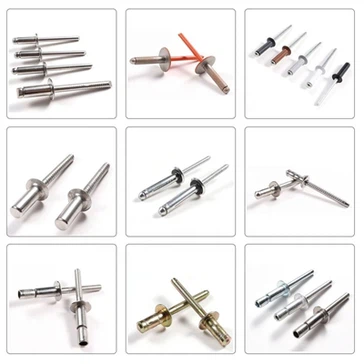
Blind rivets consist of two parts: 1. Rivet body (also known as pipe cap) 2. Nail core (also known as nail, nail rod)
The rivet body of a blind rivet is usually manufactured by the following methods (the first method is the most common): wire cold heading; sheet stamping; pipe processing.
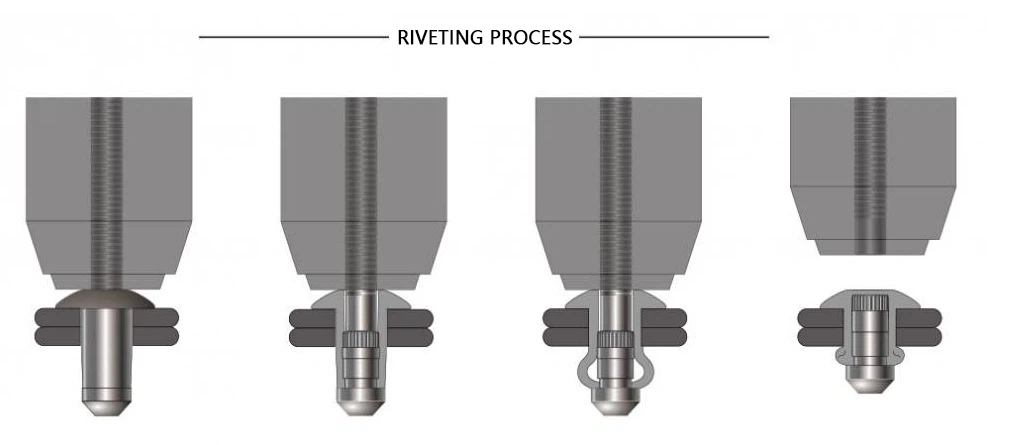
Blind rivets are particularly suitable for situations where the workpiece can only be riveted from one side. Place the rivet in a pre-drilled hole, use the matching riveting tool to pull the nail core so that the head of the nail core is pulled into the rivet body, allowing the rivet body to deform and expand on the back side to achieve fixation.
When the head of the nail core reaches the surface of the back material, the action of the nail head is blocked to form resistance, and the nail core is separated at the predetermined breaking point with the set breaking force. The strong connection formed by the rivet body is retained, and the remaining part of the nail head is fixed to the back together with the rivet body, and the broken part of the nail core falls out.
The following factors should be considered when selecting rivets:
Strength required for connection: First determine the tensile strength and shear strength required for a single rivet at the workpiece connection position. The demand for a single product can be calculated based on the total connection strength required for the workpiece and the number of rivets arranged.
The diameter of the rivet, the material of the rivet body, and the style of the rivet will affect the strength. After the standard is determined, the tensile strength and shear strength columns in the Fikes rivet catalog can be used to select suitable products that meet the standards.
Currently, the strongest structural rivets are BOM nails, also called BMW nails, Fikes model BULB-LOCK. As a high-strength structural rivet, BOM nails are ideal for high load and single-sided installation.
BOM nails (BULB-LOCK) can meet the requirements of various conventional diameters and clamping ranges from 4.8mm to 19.1mm. Unlike traditional bolts that use torque to rotate to generate tightening force, BOM nails (BULB-LOCK) use unique ring groove locking and ring groove fracture technology. Under external tension, the stretched nail rod squeezes the nail sleeve to produce plastic deformation, and the deformed part clamps the base material to achieve reliable and tight connection.
The riveting structure of BOM nails has high clamping force and high shear resistance, which fundamentally solves the problem of loosening of ordinary rivets under vibration. At the same time, it has higher precision, higher production efficiency, and excellent vibration resistance.
Thickness of the object being riveted: Measure the total thickness of the workpiece to be riveted. This will determine the “riveting value” required for the rivet you choose. Choose a rivet specification that can cover the working thickness. If the rivet is not long enough, it will not be able to properly form sufficient blind support on the back of the workpiece, resulting in a weak riveting.
Material of the object being riveted: The material of the rivet itself and the material of the workpiece being fixed will affect the final connection strength. Generally, the rivet material should have the same or similar physical and mechanical properties as the material of the workpiece being fixed. Because obvious material differences may cause riveting failure caused by material fatigue or electrical corrosion.
Drill hole size: It is important to match the drill hole size with the rivet size. A hole that is too small will make it difficult to insert the rivet, and a hole that is too large will cause a loose riveting or even rivet falling off. If the size is non-standard, please contact our sales engineer for professional advice.
Choice of rivet head type: Round head rivets are suitable for most scenarios. However, when soft or fragile materials need to be fixed to rigid lining components, large brim rivets that are larger than round heads should be considered. Large brim rivets provide twice the contact surface of ordinary round heads. If the surface needs to be flush after riveting, you can choose countersunk rivets with countersunk drilling.