
Home » Fasteners | Misunderstandings Between High-Strength Bolts And Ordinary Bolts
Reuse of Fasteners: A Sustainable Solution in Modern Construction
Reusing fasteners is a practical and sustainable solution to reduce construction waste and environmental impact. As challenges exist in different
The Hidden Threat of Fastener Fatigue
Fastener fatigue is a phenomenon that occurs when a fastener undergoes repeated cycles of stress over time which is common
Dangers of Fastener Embrittlement
Understanding the threats that can risk the integrity of components in structures such as fastener embrittlement can lead to preventing
The Future of Smart Fasteners
The future of using smart fasteners in manufacturing, construction, and other industries has a bright potential to enhance the functionality
High-Performance Fasteners for Aerospace
As technology advances and materials continue to evolve, the aerospace industry rely on innovative fastener solutions to meet the growing
Fastener Testing and Quality Control
For some applications that require intricate and reliable fastener devices like automotive, aerospace, and construction, safety is a paramount detail
Fasteners | Misunderstandings Between High-Strength Bolts And Ordinary Bolts
01.What are high strength bolts?
Misunderstanding 1:Bolts with a material grade exceeding 8.8 are “high-strength bolts”?
The core difference between high-strength bolts and ordinary bolts is not the strength of the material used, but the form of force. The essence is whether to apply preload force and use static friction to resist shear.
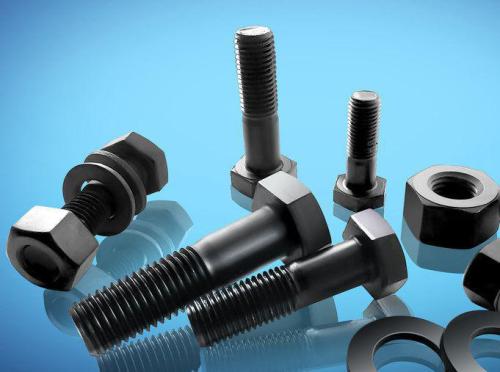
In fact, the high-strength bolts (HSFG BOLT) mentioned in the British and American standards are only grade 8.8 and grade 10.9 (BS EN 14399 / ASTM-A325&ASTM-490), while ordinary bolts include grade 4.6. 5.6, 8.8, 10.9, 12.9, etc. (BS 3692 11 Table 2); it can be seen that the strength of the material is not the key to distinguishing high-strength bolts from ordinary bolts.
02. Correctly understand “high strength”, where is the strength?
According to GB50017, calculate the tensile and shear strength of a single ordinary bolt (Class B) grade 8.8 and a high-strength bolt grade 8.8.Through calculation, we can see that under the same grade, the design values of tensile strength and shear strength of ordinary bolts are higher than those of high-strength bolts.
So where is the “strong” in high-strength bolts?
In order to answer this question, we must start from the design working conditions of the two bolts, study their elastic-plastic deformation laws, and understand the limit state when the design is damaged.
Limit state at design failure
Ordinary bolts: The screw itself undergoes plastic deformation exceeding the design allowable, and the screw is sheared.
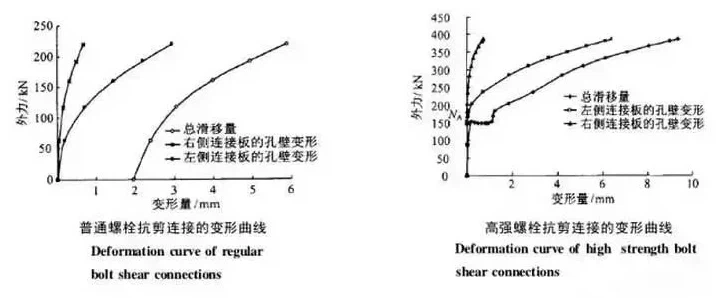
In ordinary bolt connections, relative slip will occur between the connecting plates before they begin to bear shear force. Then the bolt rod and the connecting plate come into contact, undergo elastic-plastic deformation, and bear the shear force.
High-strength bolts: The static friction between the effective friction surfaces is overcome, and the relative displacement of the two steel plates occurs, which is considered damage in terms of design.
In high-strength bolt connections, the friction force first bears the shear force. When the load increases to the point where the friction force is not enough to resist the shear force, the static friction force is overcome and the connecting plates slip relative to each other (limit state). However, although it is damaged at this time, the bolt rod is in contact with the connecting plate and can still use its own elastic-plastic deformation to withstand shear force.
Misunderstanding 2: The load-bearing capacity of high-strength bolts is higher than that of ordinary bolts. Are they considered “high-strength”?
It can be seen from the calculation of a single bolt that the design strength of high-strength bolts in tension and shear is lower than that of ordinary bolts. The essence of its high strength is that during normal operation, the nodes do not allow any relative slip, that is, the elastic-plastic deformation is small and the node stiffness is large.It can be seen that under the given design node load, nodes designed with high-strength bolts may not necessarily save the number of bolts used, but they have small deformation, high stiffness, and high safety reserve. It is suitable for main beams and other locations that require greater node stiffness, and is in line with the basic seismic design principle of “strong nodes, weak members”.
The strength of high-strength bolts does not lie in the design value of its own load-bearing capacity, but in the high stiffness of its design nodes, high safety performance, and strong resistance to damage.
03. How much do you know about high-strength bolts?
The full name of high-strength bolts is called high-strength bolt connection pair in production, and it is generally not referred to as high-strength bolts for short.
According to the installation characteristics, they are divided into: large hexagonal head bolts and torsion shear bolts. Among them, the torsion shear type is only used in level 10.9.
According to the performance level of high-strength bolts, they are divided into: level 8.8 and level 10.9. Among them, grade 8.8 only has large hexagonal high-strength bolts. In terms of marking method, the number before the decimal point indicates the tensile strength after heat treatment; the number after the decimal point indicates the yield strength ratio, which is the ratio of the measured value of yield strength to the measured value of ultimate tensile strength. . Grade 8.8 means that the tensile strength of the bolt rod is not less than 800MPa and the yield-to-strength ratio is 0.8; grade 10.9 means that the tensile strength of the bolt rod is not less than 1000MPa and the yield-to-strength ratio is 0.9.
In structural design, the diameters of high-strength bolts generally include M16/M20/M22/M24/M27/M30, but M22/M27 is the second choice series. Under normal circumstances, M16/M20/M24/M30 is the main choice.
High-strength bolts are divided into high-strength bolts pressure-bearing type and high-strength bolt friction type according to design requirements in terms of shear resistance design.
The load-bearing capacity of the friction type depends on the anti-slip coefficient of the force transmission friction surface and the number of friction surfaces. The friction coefficient of red rust after sandblasting (shot) is the highest, but from the actual operation point of view, it is greatly affected by the construction level. Many supervision units They all asked whether standards could be lowered to ensure project quality.
The load-bearing capacity of the pressure-bearing type depends on the minimum shear capacity of the bolt and the pressure-bearing capacity of the bolt. When there is only one connection surface, the shear bearing capacity of the M16 friction type is 21.6~45.0kN, while the shear bearing capacity of the M16 pressure bearing type is 39.2~48.6 kN, which is better than the friction type.
In terms of installation, the pressure-bearing type process is simpler, and the connecting surface only needs to be cleaned of oil stains and floating rust. The tensile bearing capacity along the shaft direction is very interestingly written in the steel structure specifications. The friction type design value is equal to 0.8 times the pretension force, and the pressure type design value is equal to the effective area of the screw multiplied by the material tensile strength design value. It seems that There is a big difference, in fact the two values are basically the same.
When bearing shear force and tensile force in the direction of the rod axis at the same time, the friction type requirement is that the ratio of the shear force the bolt bears to the shear bearing capacity plus the stress ratio of the screw axial force to the tensile bearing capacity is less than 1.0, and the pressure bearing type requirement It is the sum of the square of the ratio of the shear force and the shear bearing capacity of the bolt plus the square of the ratio of the axial force and the tensile bearing capacity of the screw, which is less than 1.0. That is to say, under the same load combination, the same diameter of the pressure-bearing The design safety reserve of high-strength bolts is higher than that of friction-type high-strength bolts.
Considering that the friction surface of the connection may fail under repeated strong earthquakes, the shear bearing capacity at this time still depends on the shear resistance of the bolt and the pressure bearing capacity of the plate. Therefore, the seismic code stipulates the ultimate shear limit of high-strength bolts. Bearing capacity calculation formula.
Although the pressure-bearing type has an advantage in design values, because it is a shear compression failure type, the bolt hole is a pore-type bolt hole similar to an ordinary bolt, and the deformation when subjected to load is much greater than that of the friction type, so high-strength bolts cannot bear pressure. The type is mainly used for the connection of non-seismic components, the connection of components that do not bear dynamic loads, and the connection of non-repetitive components.
The normal service limit states of these two types are also different:
Friction type connection refers to the relative slippage of the friction surface of the connection under the action of the basic combination of loads;
Pressure-bearing connection refers to the relative slippage between connecting parts under the action of a standard combination of loads;
Ordinary bolts
1. Ordinary bolts are divided into three types: A, B, and C. The first two are refined bolts and are rarely used. Generally speaking, ordinary bolts refer to C-class ordinary bolts.
2. In some temporary connections and connections that need to be disassembled, C-grade ordinary bolts are commonly used. Commonly used bolts in building structures include M16, M20, and M24. Some rough bolts in the mechanical industry may have larger diameters and are used for special purposes.
High strength bolts
3. The materials of high-strength bolts are different from ordinary bolts. High-strength bolts are generally used for permanent connections. Commonly used ones include M16~M30. Oversized high-strength bolts have unstable performance and should be used with caution.
4. The bolt connections of the main components of the building structure generally use high-strength bolt connections.
5. The high-strength bolts shipped from the factory are not classified into pressure-bearing type or friction type.
6. Are they friction-type high-strength bolts or pressure-bearing high-strength bolts? In fact, there are differences in the design calculation methods:
(1) Friction-type high-strength bolts take slippage between plates as the limit state of load-bearing capacity.
(2) For pressure-bearing high-strength bolts, slippage between plates is regarded as the normal service limit state, and connection failure is regarded as the load-bearing capacity limit state.
7. Friction-type high-strength bolts cannot fully utilize the potential of the bolts. In practical applications, friction-type high-strength bolts should be used for very important structures or structures that bear dynamic loads, especially when the load causes reverse stress. At this time, the unused potential of the bolts can be used as a safety reserve. In other places, pressure-bearing high-strength bolt connections should be used to reduce construction costs.
The difference between ordinary bolts and high-strength bolts
8. Ordinary bolts can be reused, but high-strength bolts cannot be reused.
9. High-strength bolts are generally made of high-strength steel (No. 45 steel (8.8s), 20MmTiB (10.9S)), which are prestressed bolts. For friction types, use a torque wrench to apply the specified prestress, and for pressure-bearing types, unscrew the torx head. Ordinary Bolts are generally made of ordinary steel (Q235) and only need to be tightened.
10. Ordinary bolts are generally grade 4.4, grade 4.8, grade 5.6 and grade 8.8. High-strength bolts are generally grade 8.8 and grade 10.9, with grade 10.9 being the most common.
11. The screw holes of ordinary bolts are not necessarily larger than those of high-strength bolts. In fact, ordinary bolt holes are relatively small.
12. The screw holes of ordinary bolts A and B are generally only 0.3~0.5mm larger than the bolts. Class C screw holes are generally 1.0~1.5mm larger than bolts.
13. Friction-type high-strength bolts rely on friction to transmit load, so the difference between the screw rod and the screw hole can reach 1.5~2.0mm.
14. The force transmission characteristics of pressure-bearing high-strength bolts are to ensure that under normal use, the shear force does not exceed the friction force, which is the same as the friction-type high-strength bolts. When the load increases again, relative slippage will occur between the connecting plates. The connection relies on the shear resistance of the screw and the pressure of the hole wall to transmit force. It is the same as ordinary bolts, so the difference between the screw and the screw hole is slightly smaller, 1.0~1.5mm.
Column foot anchor bolt
15. Anchor bolts have no grade, only materials: Q235 and Q345. The most commonly used anchor bolts in building structures are column foot anchor bolts.
16. Column foot anchor bolts are neither ordinary bolts nor high-strength bolts. Strictly speaking, it is not a bolt. Column foot anchor bolts generally use M20 or M24.
17. The manufacturing standards of column foot anchors should be the same as those of ordinary bolts. The embedded length of column foot anchors should be related to the friction between them and the concrete, as well as the form of the anchor bolts.
Expansion bolts and chemical bolts
18. Whether they are expansion anchors or chemical anchors, they are not connection forms in the national standard specifications. The use of such connections should be avoided, especially in important connections. Pre-embedded parts should be used.
19. The expansion anchor mainly relies on the friction between the expansion tube and the concrete to resist pulling out. The size of the pull-out force is closely related to the construction technology and human factors, so it is useless to conduct random tensile tests.
20. Chemical anchors are formed by punching holes with a punching machine, then pouring chemical slurry and inserting the bolts to achieve anchoring effect.
21. Expansion bolts and chemical bolts are actually anchor bolts. In some cases, expansion bolts or chemical anchors are needed because they are not embedded in advance. But this situation should be avoided in design. Because the anchor bolts should be embedded in advance. For example, column anchor bolts. Because only in this way can the best bonding and stress-bearing be guaranteed. Moreover, drilling holes afterwards often causes damage to the stress-bearing steel bars in the concrete and the concrete itself.
22. In the concrete specifications, components embedded in concrete are called embedded parts. According to Ministry of Construction documents, expansion bolts are not allowed to be used in curtain walls. In general, in new construction projects, expansion anchors are strictly prohibited and should be pre-embedded.